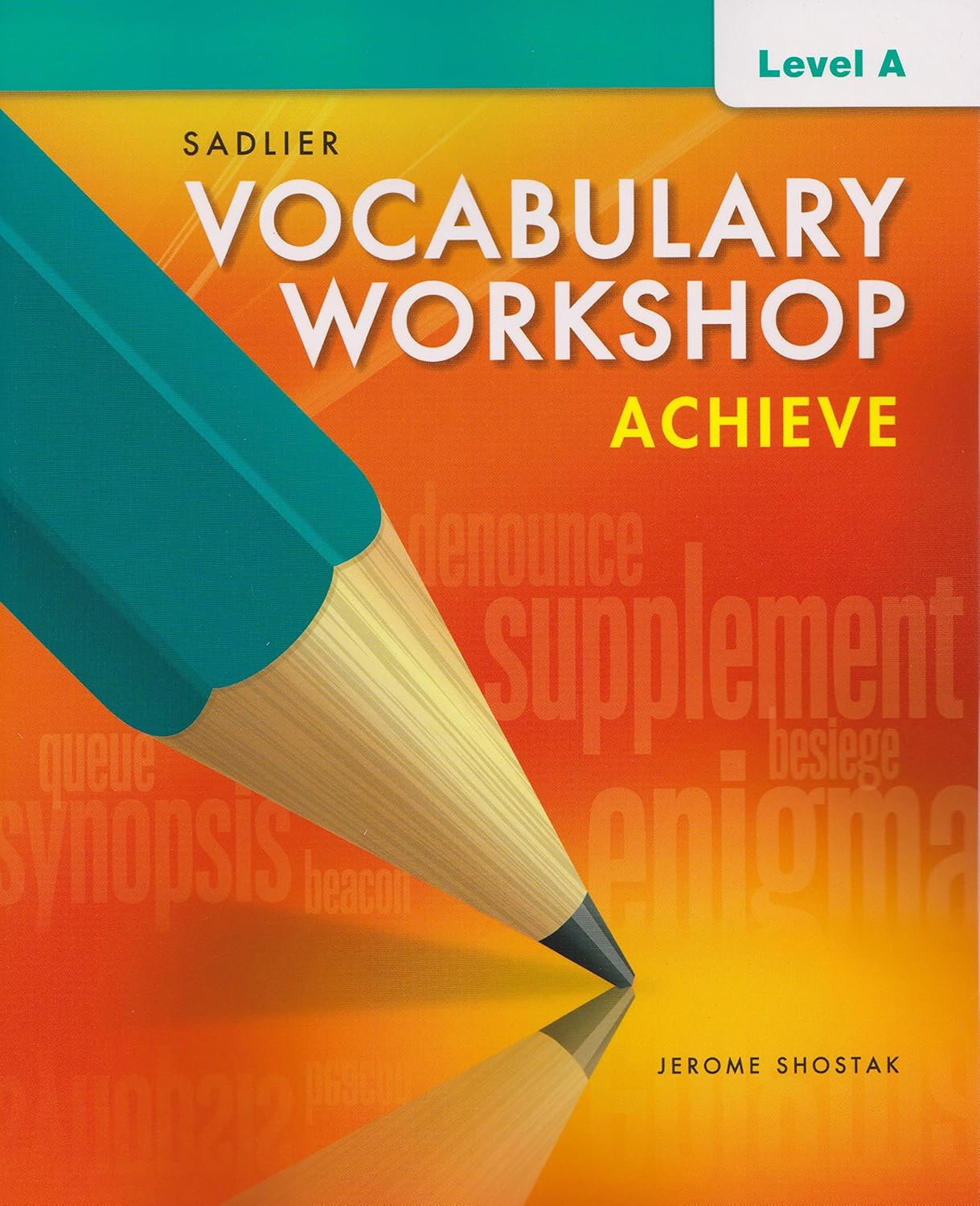
Why the Vocabulary Workshop Achieve Level A Holds Up
A structured, no-nonsense vocabulary program that sixth graders and their teachers can rely on. Sadlier has refined this format across decades, and Level A shows why it holds its place in classrooms.
The vocabulary workshop format has been a fixture in American classrooms since the 1940s, and Sadlier has spent most of that time refining it. The question worth asking isn't whether the series is well-regarded — it clearly is — but why it keeps working when so many structured curricula fade out after a revision cycle or two.
The answer has something to do with restraint. Vocabulary Workshop Achieve doesn't try to gamify language acquisition or dress up word lists with visual noise. It presents words in context, asks students to work with them across multiple exercise types, and moves on. That disciplined repetition — see it, define it, use it, identify it in a new context — mirrors how vocabulary actually consolidates in memory, which is through spaced, varied exposure rather than a single definition encounter.
For homeschooling families in particular, the Level A book occupies a useful position in a language arts rotation. It runs independently once a student understands the format, which means it can serve as a focused thirty-minute block without requiring a parent to build lessons around it. That's a practical advantage that doesn't show up in any feature list but becomes obvious in week three of a school year.
The Achieve edition also reflects updated thinking on text complexity. The context sentences draw from a wider range of registers than earlier editions, and the connections to reading comprehension are more explicit. For a sixth grader preparing for the vocabulary demands of middle school humanities and science classes, that alignment is worth having.
One honest note for parents comparing options: the Vocabulary Workshop series works best as a supplement to wide reading, not a replacement for it. The words students encounter in Level A will stick longer if they're also encountering rich text in other parts of their day. Used that way — as a structured anchor alongside genuine reading — this book earns its place on the shelf.