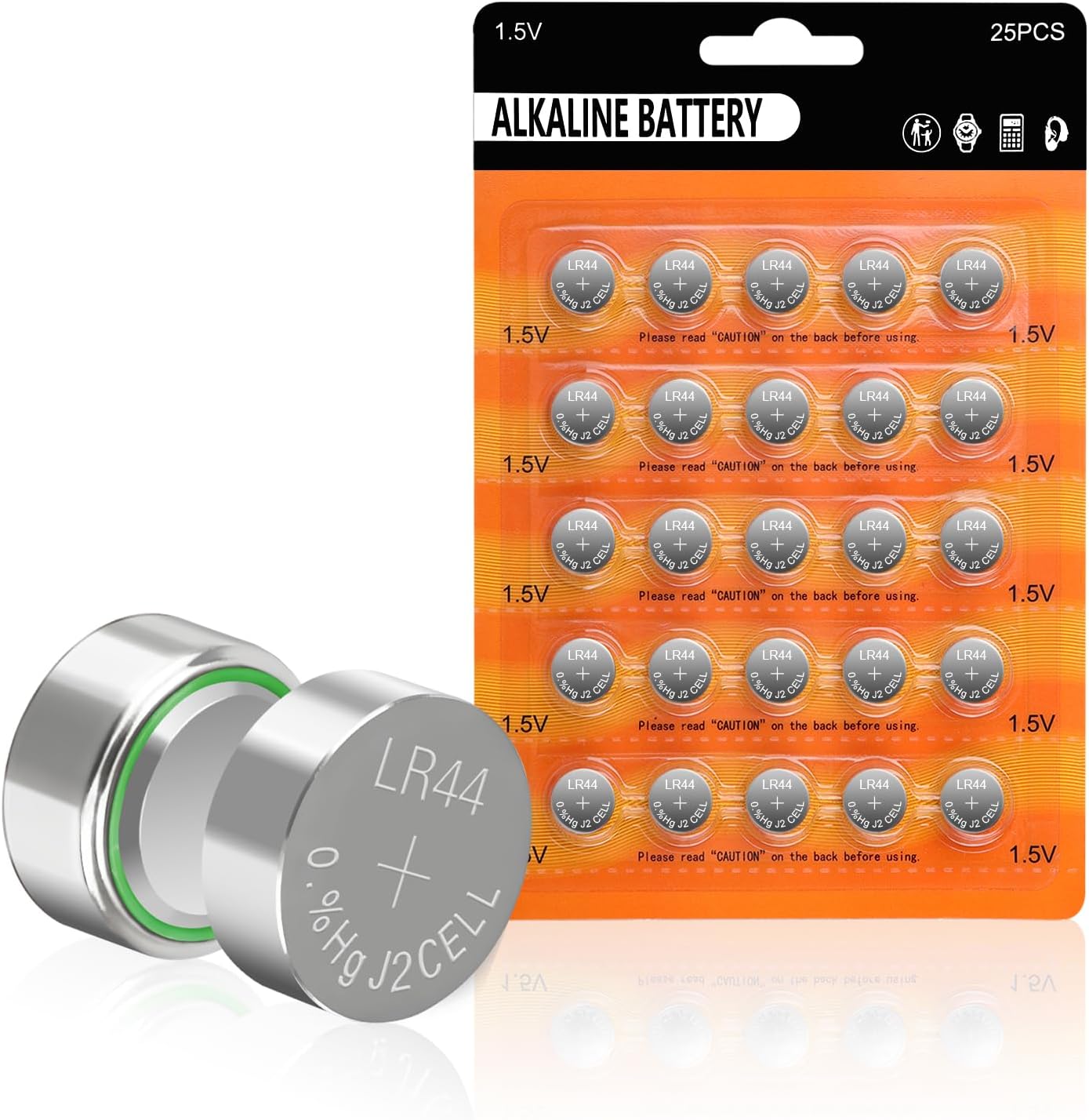
Why the Kunying AG13 LR44 Alkaline Button Cells 25-Pack Holds Up
A sensible 25-pack of 1.5V alkaline button cells that covers the LR44 equivalent landscape cleanly — mercury-free, leak-resistant, and priced low enough to stock a drawer without regret.
If you've ever found yourself standing in a pharmacy aisle staring at a single LR44 battery in a blister pack priced at three dollars, you understand the quiet frustration of button cell economics. The LR44 is one of the most common small batteries in circulation, yet retail pricing rarely reflects that. It powers the light meter in a vintage Nikon EM, the readout on a machinist's digital caliper, the blinking nose of a reindeer ornament. It is, in every sense, a workhorse cell — and it deserves to be treated like one.
The designation itself is worth understanding. LR44 is the IEC name for a 1.5V alkaline button cell measuring 11.6mm in diameter and 5.4mm in height. Depending on the manufacturer and market, you'll see the same cell sold as AG13, A76, L1154F, or 357. The 357 designation typically refers to a silver oxide version of the same physical size — slightly higher voltage and better performance in high-drain applications — but for most everyday uses, the alkaline LR44 equivalent performs identically. Knowing this lets you shop across a wider field without second-guessing compatibility.
Kunying's 25-pack enters this space with a clean pitch: mercury-free alkaline chemistry, leak-resistant construction, and a per-cell price that makes bulk buying rational rather than extravagant. For the home workshop crowd — people running digital calipers, small precision instruments, or a collection of watches that need periodic battery swaps — a stocked drawer of LR44 equivalents is just good practice. Running out mid-project is a minor but genuine annoyance that a $7 purchase eliminates for months.
It's worth noting where alkaline button cells have a real limitation. Silver oxide cells, designated SR44 or 357 in their silver form, maintain a flatter discharge curve and handle higher drain loads more gracefully. If you're powering a device that draws current in sustained bursts — certain LED configurations, electronic games — silver oxide is worth the premium. For the slow, steady draw of a watch movement or a caliper's LCD, alkaline performs fine and costs considerably less over time.
The broader takeaway for anyone searching the LR44 equivalent landscape: compatibility is rarely the issue. Physical dimensions and voltage are standardized. The real variables are chemistry, shelf life, and whether the cells arrive with enough charge to be useful. Kunying checks those boxes at a price that makes stocking up a sensible decision rather than an indulgence. Keep a pack in the workshop, one in the junk drawer, and stop thinking about it.